Random header image... Refresh for more!

My GOLDEN HALF – a Camera Review

August 4, 2009

in Plastic Camera Reviews

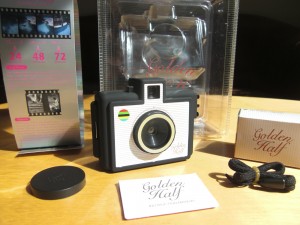
Golden Half: what's in the box

Golden Half: what's in the box

The GOLDEN HALF is a 35mm half-format plastic camera. I discovered it recently while browsing through some alternative camera sites, and since it takes odd 18×24mm pictures (that’s two in the space of a “normal” 24×36mm negative), I decided I had to have it.

After 4 weeks and several rolls of film, here’s my two cents.

I discovered this camera at the London Photographer’s Gallery, experts and stockists for plenty of Holga & Co schnick-schnack. At £35 not bad for Central London prices (hey, it even comes with a film in the box).

History

Rumour has it that the Golden Half was produced for a project by/for Ina Babylon and a book called “Life as a Golden Half”. I’m quoting from memory here, as I’ve not seen a copy of this book or found anything about this project. The name Ina Babylon may or may not refer to an actual person, it certainly is associated with the Superheadz Website, aka the makers of this rubberized pocket gadget. The entire site is in Japanese, a language fascinating yet very much a mystery to me. gh-miami-1

Luckily though, the manual is in English and even funny at times.

In a nutshell it explains the features of the camera and it all comes in a shiny plastic box, stating that you can take twice the amount of ordinary 35mm pictures (48 on a 24 roll, 72 on a 36 roll – you get the picture). It achieves this by taking a fairly small picture on a piece of film, comparable to that of 35mm motion picture cameras.

This idea isn’t new, and in fact goes way back. Had it not been for the ultimate source of all knowledge Paul Weston, I’d never have known. Apparently, Olympus made an entire SLR system around half format called the Pen F series. Very small cameras for the time (we’re talking the late 60ies here), and a whole arsenal of lenses was available. Paul even owned such a camera and says it took cracking pictures – until someone stole it from him in a changing room in Australia.

gh-miami-2

The main oddity of half-frame or half-format is that while holding the camera landscape, you’re actually taking a portrait picture, and vice versa. It’s like using the 645 gate with a Holga. It’s odd, but you get used to it quickly.

The other side effect of half-format of course is the image quality.

Paul remembers that for 6×4″ prints you don’t see a difference, but of course if you go bigger than that, grain starts becoming very visible. That’s not necessarily a bad thing; I for one am immediately thinking of funky black and white effects and overdeveloped HP5 film for an extra scoop of spookiness (see examples).

What’s in the Box

The camera comes in a choice of black or blue. Mine is black with a rubberised finish – like some versions of the Lomography Sumpersampler.

  • 1x Golden Half camera
  • 1x hand strap
  • 1x 400 ASA Kodak film (in a matching Golden Half box)
  • 1x Lens Cap
  • 1x tiny Manual, about the size of a 35mm film box. Cute!

There’s an inscription on the back, explaining the basic concept. It finishes with “So throw away your book and why don’t you go out”. I love it already!

Features

The Golden Half features a very wide lens, 22mm as the manual states. That’s probably the actual focal length of the lens, which means at a smaller frame size, this would appear even wider. A quick glance through the viewfinder confirms this – without fisheye distortion, you can capture A LOT at a time, making this an ideal tool of candid street photography. Cartier-Bresson would have loved it. Be careful though that you don’t go up too close, minimum focusing distance is 1.5 meters (60 inches) according to the manual. In reality, I’ve not had anything out of focus though.
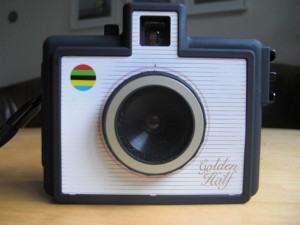
Golden Half

The Golden Half - front view

At the same time, it’s tiny compared to other film cameras. Imagine a stack of 5 Mini Discs maybe… or to say it with numbers, 9.5 x 7 x 3.5cm (that’s 3.5 x 2.5 x 1 inch) at only 84 grams not including a film (which would weigh about 20 grams). It fits neatly in the palm of my hand.

Apart from the obvious shutter button next to the viewfinder (top middle), the camera features an accurate film counter which counts all the way over 72. That’s a magical sight on a film camera, especially when you’re used to changing a roll every 12 pictures. It’s got a loupe to magnify the tiny numbers on what must be a white plastic wheel on the inside.

The film is wound to the next exposure with a plastic cog wheel, like we know and love from disposable cameras. You open the camera with a switch on the left, and there’s a little plastic crank on the bottom to rewind the film. All in all, it’s got a pretty sturdy feel to it.

Size Comparison: Holga 120, Holga 135 and Golden Half

Size Comparison: Holga 120, Holga 135 and Golden Half

On the front we find a switch for two real apertures: f8 for cloudy and f11 for sunny days (give or take 5% says the manual). I say “real apertures” here because you can actually see the hole changing, unlike on Holga cameras, where the aperture switch doesn’t work out of the box. There’s a third setting here with a flash symbol, which switches to f11 again – bringing us to yet another exciting feature: the Flash Hotshoe.

Even though it’s positioned a bit odd at the top left hand side of the camera, the Golden Half features a proud hotshoe for an external flashgun! I’ve tested this with a Canon 580 EX-II speedlite, and it works a treat. The flash fires in any of the three aperture positions, no matter if you choose flash, cloudy or sunny. Sweet!

To round it all off, there’s a tripod mount on the bottom of the camera. This might come in handy not so much for actual tripod shots, but more for accessory attachments. Sadly, there’s no bulb feature – but hey, when have I used that last?

Under the Hood

Let’s take a look at the insides of this little plastic gem.

... and that's what it looks like on the inside

... and that's what it looks like on the inside

What strikes me at first glance is that the film winds from right to left, not from left to right as is usually the case. It certainly doesn’t matter, but it’s a fact I’ve never thought about. All cameras I’ve worked with wound the other way round. Interesting.

You don’t have to lift the crank on the bottom, the film canister just fits in without mechanical shenanigans. The take-up spook is fairly thick, which is nice for the film. There’s a slit in the spool into which you can insert the film, which makes loading the camera very easy.

The bottom sprocket is used to crank up the leaf shutter, which must be a very thin plastic plate. The manual states that it fires at 1/100th of a second. There’s a thin clear plastic sheet in front of the shutter, possibly for protection. No pressure plate, just simple grooves to hold the film in place.

As for the lens, it certainly looks like it’s made from pure plastic. I’ve just seen some scanned results, and it looks like at f8 there’s a good sweet spot of about 50% in the middle, with fairly blurred edges (depending on the shot). Reminds me of the Holga look through and through. I’m sure at f11 we’d see more of the sweet spot, and a less blurred edge.

Let’s see some pictures

I’ve had the privilege of shooting about four rolls with the Golden Half already, and I’m impressed! Just what I was hoping for, especially when it comes to black and white.

The following pictures are mostly from my first roll – actually colour film developed in black and white chemicals. Hence the eerie feel. I’ve got some others coming up on Flickr shortly.

gh-roll1-34-of-45 gh-roll1-24-of-45

If you like the look of harsh grain and super 8 movies, this one’s for you. Add to that the small and lightweight size, paired with a huge arsenal of pictures you can take, add in some unpredictability (as is awlays a good ingredient with plastic cameras), and have fun.

I think the Golden Half, like the Holga 135 BC, is going to be a key part of my 35mm work from now on, especially in black and white. I’ve shot some stuff on colour too, and will post it in my newly created Flickr Golden Half Collection if and when it’s scanned. Keep an eye out.

Conclusion

If you’re into alternative photogrpahy and find odd formats fascinating, this is for you. If you’re looking for a cheap plastic camera and want to cut down on processing costs – understandable in the current financial climate – go and invest.

Films can be processed on the high street, although you’ll see two pictures side by side rather than singles (as shown in these examples). If you’re not into that, order larger prints and cut them in half. If you’re scanning your results like I do, be prepared for some long sessions – after all, you’re creating dozens of images per roll.

Where to get it from

  • eBay (of course)
  • Photographer’s Gallery in London
  • Holga Magic (very slow server)

{ 2 trackbacks }

Lomography Oktomat Review: the 8-eyed art machine
August 26, 2009 at 11:33 am
Tutorial: Getting “The Grunge Look” in your photos
February 15, 2010 at 9:08 pm

{ 21 comments… read them below or add one }

Barbie August 22, 2009 at 6:40 pm

Hi there, I just was reading your review after purchasing a Goldenhalf. I was hoping you could help me. I don’t have anything to use for a flash and don’t really know where to purchase or what to purchase to attach to the camera to get a flash. Could you please give me a suggestion and email it to me? I’d really appreciate it. Thank you!

Jay Versluis August 23, 2009 at 11:03 am

Hi Barbie,

glad to hear you like my review, and that you’re enjoying the Golden Half.

Any standard hotshoe flash will work with the Golden Half, like the speedlights from Canon and Nikon. However, they’re very big and very expensive.

Have a look at http://www.holga-magic.com, he’s got some very small units available, which should work fine. I’ve ordered a couple but they’ve not arrived yet– I’ll let you know when they do and will post some pictures.

Shovan Gandhi October 16, 2009 at 12:32 pm

hi jay

i was surfing online trying to look for info on plastic cameras, and bumped into your site. i need some advice on a new plastic camera i recently recieved as a gift.

it’s a golden half camera, and it seems uev reviewed the same. i have a nikon sb800 flash which i want to use with this…have you ever tried this camera with a pro flash??
it seems to work very inconsistently, the flash does not fire a lot of times when you trigger the shutter.

i had made all manual setting on flash so that it would do the job, but didnt really help also came across another side which explains the one pin connecter (in the hotshoe of the half) and the 5 pin in the flash and how it is probably a good idea to tapeup the extra pins to prevent the flash from shorting out. again didnt really help

flash works every 5-6 images and then doesnt…i am not looking to buy any other one as i know this can work. it would be great if you can give me some ideas on how to go about it.

thanks a lot

Shovan

Jay Versluis October 16, 2009 at 12:43 pm

Hi Shovan,

I’ve used the Golden Half with Canon’s 580 EX-II (that’s the eqivalent to the SB-800 in Nikon’s universe), and it worked fine. But then, I’ve not taken more than a couple of shots in a row.

I would suggest the same thing about taping up the extra contacts; the Canon has 5 pins at the bottom too, and only the middle one is used to actually trigger the flash. Obviously, those two have to be lined up for this to work. I remember it was a bit tricky to pop the flash into place, maybe it’s just a matter of pushing it back a bit, or forward to line up that middle contact.

If that doesn’t work, there’s always the possibility of something being wrong with your Golden Half.

The more important problem I guess is that your flashgun is 8x the size of the actualy camera ;-)

I’ve recently bought a very small Holga 12MFC flashgun that runs on only one AA battery. It’s about two thirds of the size of a Golden Half and works a treat (it only has one contact at the bottom).

Hope this helps!

Lila November 27, 2009 at 2:39 pm

hi jay,
I’ve just bought a golden half camera and am wanting to buy a holga diana flash to go with it. Do you think it would work well?

Jay Versluis November 27, 2009 at 4:21 pm

I’m glad you did ;-)

Yes a Holga Flash like the 12MFC (see below) will work fine. This particular one is very small, about the size of the Golden Half, and comes with 4 colour filters and a frost filter. Works on only one AA battery- check it out at Holga Magic.

I’ve tested it with the Golden Half and the Blackbird Fly TLR – works a treat.

Darko Bojanic January 25, 2010 at 9:37 pm

Hi Jay!

Really liked your review of the Golden Half. I was looking for the Diana Mini and bumped into this and it seems that this is a better camera than the Diana Mini. I am even more confused now but still this little Goldie cam made me think again…

I have been shooting with a Holga for a while and are looking for a 35mm alternative and this might be the one. I think there is a reason I bumped into your site..

Thanx again!

Jay Versluis January 26, 2010 at 7:52 pm

Hi Darko,

thank you so much, I’m really glad you liked it. I’ve tried the Diana Mini on a number of occasions and have been meaning to write a review about it – it’s not half as good as Lomography wants you to believe it is. The “plastic look” really suits the Holga and the Diana 120, and I love what they’ve done to miniturise it. But in reality, the Golden Half is a much better half-format camera than the Diana Mini.

Thanks for leaving a comment, and happy half-format snapping ;-)

Suzylee February 2, 2010 at 4:37 am

Heya, just thought i’d add a comment…
Bought a Golden Half last week from GoodasGold in Wellington NZ, getting the first film developed today, i hope it comes out good as i kinda just went crazy with the first film to get a feel for it. I saw the book ‘life as a golden half’ on google before… might look into it more later. Thanks for the great write up, very helpful.

Adelaide February 4, 2010 at 3:27 pm

Just wanted to say this was a great review. I’ve used the Golden Half camera too for some great funky shots. As well as being extremely easy to use, you never have to keep popping in a new film so the shots just keep on coming. So fun and easy to pop in your bag or even your jeans without it getting in the way. The handy size makes you more likely to want to carry it around with you for those off the cuff shots, than dragging around a less inconspicuous very expensive piece of kit and the results blow you away each time. I think it works best with Black and White film but that’s just me : – ) happy halving everyone : – )

Pawally via Flickr February 6, 2010 at 9:43 pm

Hi Jay

I just had a question about the Golden Half camera. It seems really cool to have and I could never take too many photos so this seems perfect but I was wondering if the quality and the build of the camera is good. Also, I noticed the prints you scanned were only one picture, not two pictures in one print. So when you get the film developed, do they just cut each picture, even though the camera takes two pictures for each frame?

Thanks.

Jay Versluis February 6, 2010 at 9:45 pm

Hi Pawally,

thanks for your mail, I’ve taken the liberty to post it under my review as a comment – maybe the explanation is relevant to other viewers as well.

In terms of build quality, the Golden Half is a very lightweight yet solid piece of kit. The film winder is a sprocket which is unlikely to break and the shutter has a solid button with a leaf shutter (again unlikely to break). In a nutshell it’s very well built.

As for the double-pictures: the Golden Half takes negatives at a size of 24×18mm, which is half of a standard 35mm negative (24×36mm). Mini Labs are setup for the latter format, which is why if they develop and print your film, you’ll end up with two pictures side by side on one print.

I like to scan the images individually – or you could in fact cut the prints like you suggested.

Hope this helps ;-)

Pawally February 12, 2010 at 8:37 am

Ah ok, thanks. Yeah, one of my concerns was if it would break easily so its good to hear it’s solid. This is my first forray into the world of toy cameras and there are so many choices and quirky cameras haha. Do you have any other suggestions that I can look into? It seems like the Diana Mini sounds like a cool camera too.
Thanks :)

Jay Versluis February 12, 2010 at 8:49 am

I know what you mean about the choices – there are plenty of plastic cameras around. I think a good idea is to get started with 35mm instead of 120 just because it’s cheaper, and the first few rolls may well become a learning curve.

The Diana Mini certainly looks good on paper – but be warned: it isn’t in reality! It’s more like an overpriced marketing gimmick by Lomography with fairly cheap components and unconvincing results. Watch out for a full review coming soon (which I’ve been meaning to write ever since the Diana Mini came out…)

My recommendation would be a Golden Half, or the Holga 135 BC. The latter is a bit larger but a very solid (and affordable) camera. Stock up on fast film while you’re at it (400 or 800 ASA).

Happy Shooting!

GennaLeigh February 15, 2010 at 3:19 am

Jay. Thank you. I’ve been daydreaming about photographing in this image quality- and I’m ecstatic to come across your site.
I’m confused a bit on your black & white photographs. You wrote ” Here’s a roll of Kodak T-Max shot in Miami Beach in July 2009. I’ve developed it in Ilfotec HC, pushed to 3200 ASA.” I’m kinda new to this game, and was hoping you can tell me how I can get to same picture quality.
Most importantly: If I used black & white film and have it developed for me, will the quality be anywhere in comparison? (At one point you mentioned you developed your color film with black & white chemicals. ) Can I take pictures on color film and even get them developed in B&W?

I know its a lot of questions, its just that I’m super into the photographs you shot.

katie February 15, 2010 at 4:48 pm

Hi! You seem like bit of an expert so i was wondering if you could explain this for me…. i bought this camera last week but my instructions are in chinese! after i take a picture do i just wind on for the second one on the same frame? or is there some fancy way it works? thanks :D x

Jay Versluis February 15, 2010 at 9:15 pm

@GennaLeigh
Thank you so much – I’m glad to see you so excited about those pictures ;-)
In answer to your question about image quality, have a look at this new article I’ve written today, in response to you. It explains how to get “The Grunge Look” in your pictures. It also covers colour film in black and white chemicals, and the lingo you need to lay on your lab to make them bring out harsh grain.
Good luck and happy shooting!

Jay Versluis February 15, 2010 at 9:23 pm

@katie
Ah, Chinese instructions… that’s no good (unless you’re Chinese of course). Take a look at this – courtesy of the Holga Magic website.
You are quite right: take a picture, then wind the knob until it stops – now you’re ready for the next exposure. Each picture you take is 18×24mm on the negative, so when you give the film to the lab, they’ll print it as if you shot 24×36mm – hence you end up with two pictures side by side.
Have fun ;-)

Pixie February 18, 2010 at 3:55 am

Hi, thanks a lot for your review on Golden Half! Just purchased one goldie myself! :)
I’m wondering if it’s possible to add on lens like fish eye on the golden half? e.g. buy holga’s fish eye lens and add it onto holga..

Jay Versluis February 18, 2010 at 9:40 pm

@ Pixie
Glad you liked the review – have fun with your new Goldie!
There’s no thread around the lens area of the Golden Half, so you won’t be able to attach any accessories or filters. However, there’s nothing stopping you from holding one in front of the camera while you take the shot! I’ve used the Holga Fisheye Adaptor many times on other cameras and the results are rather cool. Give it a shot ;-)

Neil February 19, 2010 at 10:06 pm

The Golden Half is fantastic, fun little camera. I’ve owned two (first one was stolen) and both have the peculiar quality (due to the relatively cheapo plastic lens I’m guessing) of giving many pictures a sort of “tilt-shift” effect whereby there’s a sharp band across the middle of the photo with top and bottom areas out of focus. It can be a pretty cool effect actually and it’s this kind of quirk that makes me love plastic cameras.

Leave a Comment

Previous post:

Next post: