Random header image... Refresh for more!

My Holga 135BC Review

by Jay Versluis on July 13, 2009

in Plastic Camera Reviews

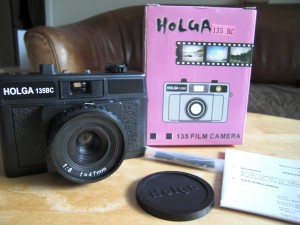
Holga 135BC - what's in the box

Holga 135BC - what's in the box

I’ve had my eye on this camera for a while – like every Holga Nut I imagine… who could resist the temptation of another Holga, especially if it’s different to the ones we know and love? Unlike its big brothers, this one takes standard 35mm film and produces 24x36mm negatives – easily processed on the High Street.

I rushed down to the Photographer’s Gallery last week to get the Holga 135BC, and I couldn’t wait to try it out. But before I show you the breathtaking results, here’s what this camera is all about.

There are two versions: the Holga 135 and the Holga 135BC. As I understand it, the only difference is a pink sticker on the BC version, and the fact that BC stands for “black corners”. This one should produce stronger vignetting, while the non-BC version shouldn’t.

Although there are no clues on the package or the manual, it’s fair to assume that this little baby is made by Tokina in Hong Kong, along with the rest of the fabulous Holga family.

What’s in the Box

We have the following ingredients at our disposal:

  • 1x Holga 135BC (nice!)
  • 1x Lens Cap with HOLGA written on it (I think all the new ones have that since 2008/2009)
  • 1x pink box with example photos, a “drawing” of the camera featuring some monkey sticker. Note that the word “Holga” is written in a different font than what’s on the lens cap, the camera and previous boxes (I guess they’re not branding specialists – which makes it more attractive to me)
  • 1x user manual
  • and one of those hand straps that you *can* attach, although nobody in their right mind ever would

The Outside

Plastic. Cheap plastic, that’s what we like. But unlike his bigger brother, this one is really well built. The back doesn’t come off completely (it’s hinged, like on a proper camera). There’s a film counter on the top (just like on a proper camera), and the shutter button is at the top, not next to the side of the lens. Speaking of which, you can screw in a cable release for long exposures.

As for features, they’re almost identical to the 120 version: at the bottom, you’ve got a switch for “normal” and “bulb” settings, so double-exposures or as-long-as-you-press-the-button exposures are back with a vengeance. Of course there’s a standard tripod mount. Nice!

On the top there’s a hot shoe for an external flash, and we also have that notorious aperture switch. Just like the 120 version, it technically works, but both apertures are the same. Should make for easy modding I would hope. The lens barrel (if you want to call it that) has the same outer dimensions as the 120 version, so all accessories should fit like a glove. I love it when manufacturers do that!

The Inside
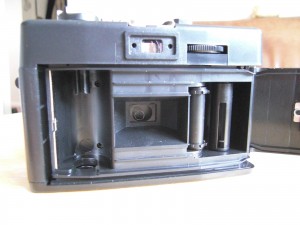
This is how the vignetting is created: there's a translucent cut-out mask 1cm behind the lens

This is how the vignetting is created: there's a translucent cut-out mask 1cm behind the lens

Under the hood, things look a bit different. The film winds from left to right, like on standard 35mm cameras. However, it unwinds counterclockwise (as determined by the cartridge), and winds into the camera clockwise. I’ve not seen that before! It’s a great idea though, because it makes the film less curly when you come to handle it for processing or scanning. If this is in fact the reason behind it, who knows.

Tha back pops open by lifting the film rewind knob. You wind the film with a wheel at the top right, like on a disposable. Film transport is done by a sprocket next to the film chamber, and a 1cm thick take up spool. All the components, like the rest of the camera, have a very sturdy feel to it.

If you look closely at the film chamber, you can see a translucent mask behind the lens that covers the corners – the responsible part for creating that great vignetting effect.

Pages: 1 2

{ 69 comments… read them below or add one }

Bellbird, fly February 13, 2011 at 10:23 am

Hi Jay,

I’m about to try my first roll of Ilford Delta 3200 in my 135BC. I was hoping to do at least half the roll at night with no flash or tripod (with the available light being major intersections and busy bridges). What should I tell the lab to push it to in order to get some of those shots to turn out? I’m prepared for unearthly (or very earthy) grain but was hoping not to have them go higher than 6400.

Also, thanks for your comprehensive review of the 135BC which helped sway me to pick one up a while back and it has since become my go-to toy cam.

Thanks,

Dave

Reply

Jay Versluis February 13, 2011 at 11:28 am

Hi Dave,

glad you’re enjoying the 135BC – it’s one of my favourites too. My experience with very low light or night shots is that even at ISO 12800 at “normal” exposure (i.e. 125th shutter speed) you’ll hardly see anything on the film. Your best bet is to use bulb mode and do about 2-5 seconds of exposure manually. Which means without a tripod you’ll get a lot of motion blur.

Developing Delta at ISO 12800 produces more grain than at 3200 but not so much as to renders 35mm pictures unusable – I still like the look but that’s personal preference of course. The best advice I can five you is to do some testing and see what works best for you. Also if you have access to a light meter take it with you and see what it says – it’ll give you some idea of what the Holga and the Delta 3200 will see.

Have fun ;-)

Reply

Bellbird, fly February 13, 2011 at 4:39 pm

Jay,

Thanks for your swift reply. Yep, I’ll bring my tripod along for sure then. I’m comfortable and have had good results with the bulb mode. One more question though: For night shots with a tripod (2-5 seconds), what would be the minimum ISO I would ask my lab to process it at? I’m just looking for a rough number to tell them for my first roll and then I can tweek things from there. I want to make the most of this roll because the supply of Delta 3200 here seems to have (hopefully only temporarily) dried up.

Thanks again,

Dave

Reply

Jay Versluis February 13, 2011 at 5:03 pm

I’d say if you’re starting out and want to see how it all comes out start with the default development of 3200. You may find that it’ll be enough for what you need. If you find you’d like a stop or two more, push the next roll or part thereof.

For accurate testing you should take the same picture on the same film with the same exposure time, then have three different development runs and compare how things come out.

If you can’t get hold of Delta 3200 anymore, try the excellent (and sometimes cheaper) Kodak T-Max 3200 – Calumet do this for under £4 per roll. There’s also Fuji Neopan 1600, or of course Ilford HP5 (you can push that to 3200 easily).

Reply

Bellbird, fly February 22, 2011 at 3:25 pm

Jay

Thanks again for your reply.

Calumet have a pretty good selection of films but unfortunately they don’t deliver to Asia. There’s an abundance of HP5+ here though so that’s the route I’ll take.

Until next time,

Dave

Theda Matousek June 15, 2011 at 5:34 am

Helped me a lot, just what I was searching for : D.

Reply

Courtney July 25, 2011 at 4:30 pm

Hi Jay,

When I got my original 120 format Holga I modified it to fit 35mm right away. Had you tried that? I love it especially for the spoke holes it created.

I’m really enjoying your blog! I have such a weakness for plastic cameras! Also, I need to thank you for the scanner recommendation you made in some comments on another post. I’m waiting for mine in the mail now. So excited! This is going to save me a lot of money. I looked at the Epson330 but opted for the Epson Perfection V500!

Reply

Jay Versluis July 27, 2011 at 10:08 am

Hi Courtney,

the v500 was a great choice – well done! You’ll have hours of fun and never have to beg a lab for scanning your negs ever again!

Thank you for your comments about my site, it’s always nice to hear. Plastic Cameras are so addictive, aren’t they? Let me know where I can see some results ;-)

Reply

Courtney July 27, 2011 at 7:19 pm

Thanks for the reply! The scanner arrives tomorrow! Picking up my first batch of negatives to get experimental on tonight. I can hardly stand the wait. I post almost everything on flickr if you’re on there please add me :-)

http://www.flickr.com/people/cbrowncolors/

Reply

Pia November 13, 2011 at 10:28 am

Hello! I just ordered a 135BC Holga and I’m still having second thoughts ’cause I was originally opting for a 120N. I decided to go with the 135bc ’cause 35mm film is cheaper than 120′s. And since I’m on a “student’s budget” I decided to go for what could make me spend less.

But I just wanna ask if you think I made the right decision by going 35mm instead of 120? And is there some glitches to the 135 that I have to look out for?

Thanks in advance! I really enjoyed this set btw.

Reply

Jay Versluis November 13, 2011 at 11:03 am

Hi Pia,

you’ve made the right decision about the 135BC – 35mm film and processing is cheaper than 120 unless you do it yourself. The camera is more sturdy than its 120 counterpart and delivers “excellent” plastic results. Purists would argue that the BC (back corner effect) is somewhat faked due to the inset they’re using behind the lens, nevertheless I love the results especially in black and white.

120 has a very different feel to it and I recommend you get one when you can afford it – even if it’s only for a couple of rolls. Medium Format film is amazing and the Holga 120 is superb due to its super cheap plastic construction. But like you say, stick with the one you can afford to run and see what the future brings.

Happy shooting ;-)

Reply

Leave a Comment


Notify me of followup comments via e-mail. You can also subscribe without commenting.

{ 2 trackbacks }

Previous post:

Next post: